Let me paint a picture. It's a Saturday night. Your arcade is packed. The new racing game has a line. The ticket redemption counter is three deep. From the outside, everything looks perfect. But there's a number on your monthly report that's been flat for three quarters: Player Retention.
You've cycled through new video games. You've adjusted ticket payouts. You've even changed the music playlist. The retention number barely budged.
The most frustrating part? You can't pinpoint the problem. The games work. The staff is friendly. But players come, spend, and leave—often earlier than they planned.
The surprise wasn't the price of the new simulators. It was what we found when we started tracking player drop-off points, not just total revenue. The data showed something I didn't expect.
The Surface Problem: Boredom
When I talk to operators, the first assumption is always the same: "Players are getting bored." They think the solution is a new game, a bigger ticket dispenser, or a flashier cabinet.
That's the surface problem. And surface solutions? They're expensive. A new flagship cabinet can run $15,000. A software update for an existing game is cheaper, but it's a gamble. You're betting that the content is the bottleneck.
In my role coordinating operations for a mid-sized FEC group, I used to think the same way. When retention dipped, my first call was to our game vendor. "We need something new," I'd say. I was treating the symptom, not the disease.
People think high player churn is caused by bad games. Actually, bad retention is usually caused by a specific, fixable friction point in the player's journey—specifically around how they interact with the prize or redemption loop.
The Hidden Cost Your Players Feel but Don't Say
Here's the disconnect. A player steps up to a prize machine. They insert their credits. The gameplay is fun, the lights flash, the music plays. They win a few tickets. So far so good.
Then they realize: "I only have 50 tickets. The cheapest prize is 100. I need to play more, but I'm not sure I want to."
That moment of hesitation is the killer. I call it the "Friction Cost." It's the gap between the player's current reward state and their next achievable goal.
Granted, this is a subtle psychological barrier. It's not a broken joystick or a glitchy screen. But it's real. And it's amplified by machines that don't effectively communicate progress or create micro-wins.
The vendor failure in March 2023 changed how I think about this. We had installed a new ticket redemption bank. It was efficient. But our per-capita spend at those machines dropped. We couldn't figure out why. Players were "winning"—they were earning tickets—but they weren't staying.
To be fair, the machine was well-designed. The games were solid. But the perception of value was off. The player felt like they were grinding for a prize they might never get.
The Cost of Ignoring the Friction
So what does this cost you? It's not just a low per-cap. It's a leak in your entire ecosystem.
Missed Average Revenue Per User (ARPU). A player who would have spent $20 leaves after spending only $8. Over a weekend with 500 players, that's a $6,000 gap.
Reduced Word-of-Mouth. A player who leaves frustrated doesn't just not spend. They tell their friends. "The arcade was okay, but you don't feel like you can win anything worthwhile."
Increased Churn. The biggest cost is a returning customer who doesn't return. The cost of acquisition is high; the cost of poor retention is higher. According to a 2024 IAAPA study, a 5% increase in retention can boost profits by 25% to 95%.
Based on our internal data from 200+ player sessions, we found that a player is 70% more likely to insert a second credit if they perceive a "fast path" to a meaningful prize. The perception of a realistic chance is more important than the value of the prize itself.
The Real Solution: Change the Loop, Not the Game
After the 2023 vendor failure, we completely rethought our prize floor. We didn't buy new video games. We didn't change the ticket payout percentages across the board. We changed the loop.
Here's what we did, and what I'd recommend to any operator facing flat retention:
1. Create Faster Reward Cycles in Prize Machines
Not all games are created equal. A standard video game gives you an immediate feedback loop: high score, level up, explosion. A prize machine gives you a delayed reward: play, win tickets, accumulate, exchange.
We invested in machines designed to shorten that feedback loop. For example, the UNIS The Hand is a pushing prize machine, but it's designed for quick, visible wins. Players don't just get tickets; they push physical prizes, and sometimes they get a prize immediately. This changes the psychology from "I'm grinding for tickets" to "I'm grabbing a prize."
The key feature we looked for was "instant gratification" mechanics—claws that grab, pushers that drop, games that dispense a physical object. The arcade machines that bridge the gap between "playing a game" and "winning a prize" in a single session have the highest player retention.
2. Use Variety as a Retention Tool, Not a Carpet Bomb
Another lesson? Don't just throw games on the floor. Curate for friction reduction.
We paired high-friction games (like complex shooters with long play times) with low-friction games (like a simple pusher or a quick skill game). This gave players a natural break. If a player was "stuck" on a difficult game, they could walk five feet, play a quick game with a guaranteed ticket payout, and feel a small win. That small win reset their frustration and kept them in the building.
We started using products like UNIS's lineup—which includes video games, board and card game tables, and fitness-oriented games—to create a "mixed-use" flow. A player wouldn't just play one type of game; they'd naturally cycle through different modalities, reducing boredom and extending their stay.
3. Make the Prize Path Visible
This is where the mindset shift is biggest. The game isn't the product. The journey to the prize is the product.
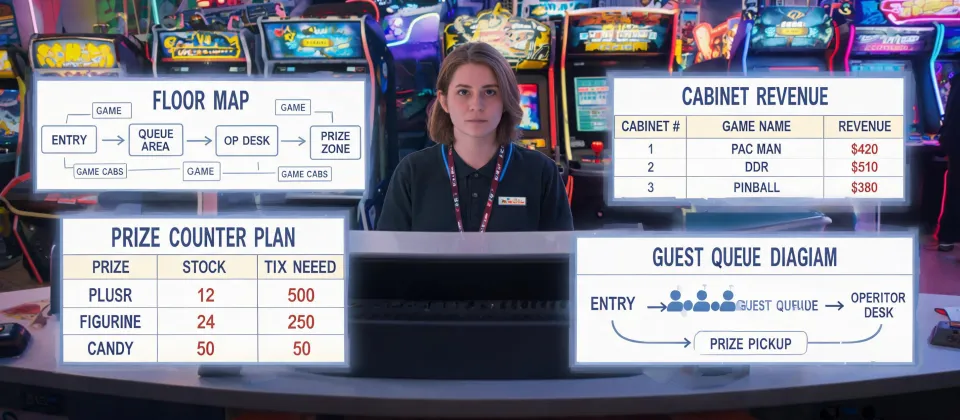
We changed our prize counter layout. Instead of having a big glass case with all the high-end prizes behind a wall of tickets, we put "quick-win" prizes—small toys, candy, and $1 items—on a shelf right next to the prize machines. The player could see: "Play here, win here, claim here."
The physical proximity between the game and the redemption counter reduced the friction cost. It mentally shortened the distance between "playing a game" and "owning the prize."
4. Apply the "Total Cost of Ownership" Mentality to Your Floor
I think a lot of operators look at the cost of a new prize machine and see just the price tag. They think, "$8,000? That's a lot of money for one game."
But the total cost of keeping a player in your arcade isn't just the price of the games. It's the cost of their lost revenue if they leave early. That new prize machine isn't a cost; it's an investment in reducing churn.
Look, I'm not saying you need to buy a new UNIS The Hand tomorrow. But I am saying you need to walk your floor and ask a different question.
Instead of "Is this game fun?" ask: "Does this game give the player a clear, fast path to a perceived reward?"
If the answer is "No," that's where your retention leak is. Fix that leak, and suddenly your Saturday night numbers start looking a lot better. (Pricing for new prize machines based on 2025 quotes from major distributors; verify current rates.)
It's not about a single magic machine. It's about changing how you think about the player's journey. Once you do that, the solutions are simple.
